Pixel Qi Screens debuting in Tablets
It seems a comment that I made at the Magazine Innovation Summit in NYC this week should be clarified:
While we are supplying screens for tablets (and ebooks, and netbooks too!) and are starting production shortly, including supplying limited volumes earlier than our official mass production start - we can’t say when these products will be announced and sold retail.
Sorry not to be able to reveal more, but our customers: the netbook, ebook and tablet makers really need to announce their products on their schedules.
New Subject - Battery Life Standards
While I have you I wonder how you all feel about MobileMark? This is the standard that sets battery life measurements with screen turned down to 27% brightness or 60 nits (max brightness is usually 220 nits). A nit is a unit of brightness. This from the latin “nitare” which means “to shine”, as opposed to the German origin of the more common use of the word nit - from the egg of a parasitic insect, usually a louse.
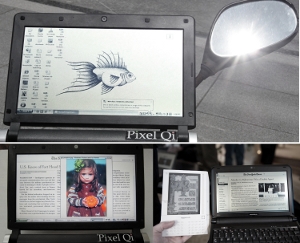
In office lighting, a piece of paper that reflects 60 nits is quite readable. Our screens with good office lighting also reflect 60 nits or more - I measured 120 nits in our offices on Friday. This with the backlight off. The exact reflectance measurement depends very much on the room lighting.
A normal LCD screen is “washed-out” by the office lighting since it can’t use the room lighting to show the image. The backlight is what creates the brightness (nits) on a normal LCD screen. For traditional transmissive LCDs, the backlight has to be cranked up higher because it competes with the room lighting. So it’s hard to see a normal LCD screen at 60 nits of brightness because 60 or more nits of office lighting can also be reflecting off it, competing with the LCD’s own image, often obliterating the screen image viewability completely. This is mostly true for matte reflection screens. There are also “glare-type” screens. These screens look shiny. The user sees their own reflection in them - no matter how beautiful you are this can be a problem: It’s distracting and hard to read because of all the reflections that complete for attention with the screen image.
Back to battery life measurement standards:
MobileMark seems to (according to our laptop-making customers) require that we also crank the backlight up for the power measurements to the same level as other screens that aren’t reflective and in fact are hard to read even at 60 nits backlit brightness in roomlight - this even though with no backlight the Pixel Qi screen can exceed 60 nits of brightness without any “wash-out” or annoying glare.
Does this make sense?
- Mary Lou
Trackbacks & Pingbacks
- Pixel Qi display technology “coming soon”
- Pixel Qi displays to ship soon - OEMs only | TeleRead: Bring the E-Books Home
- Pixel Qi displays shipping to OEMs soon « Diet Recipes Free
- Pixel Qi displays shipping to OEMs soon | GadgetPaper.com, Daily Gadgets, Mobile Phones, Computers, Laptop, Electronics, MP3 Player, GPS, Video Player, and Related Technology News
- I display Pixel Qi pronti per gli OEM - schermi netbook, lcd netbook, epaper, visibilità schermi netbook - Netbook News
- Painéis LCD que podem ser lidos sob a luz do sol chegam ao mercado « Training Tecnologia
- Where is the CrunchPad? Could Pixel Qi be behind the holdup? | UMPCPortal - Ultra Mobile Personal Computing
- Back For Life EBook. | 7Wins.eu
I hope these tablets have displays that are between 5 and 6.5 inches (6.5 inches is acceptable if it’s a lengthwise long aspect ratio form factor). Anything more than that can’t fit in my pocket. Smaller than 5 inches isn’t that great for a tablet. Also for compactness i hope that the frame margin isn’t too wide .. cause that is unnecessary width because it’s not a display surface .. i prefer length to wideness. Why do gadget manufacturers insist on a big margin to the edge from the display surface?
Obviously because it allows holding the screen without touching the touch area.
For the battery life standards… NO it does NOT make sense. Considering I need a bit of light even when working on most notebooks (for only view have keyboard backlight, which rather is a waste for mobile devices I think) such standards should allow to assume book-reading enabling room lighting.
I guess Ebooks lack standardised battery tests, don’t they? Considering, most Ebook-Readers, if not all, do not allow installing custom software, from what I know. This type of test would be right for a 3Qi screen.
Still those more common battery life tests stay valid for some usage scenarios I guess.
Anyway, please urge some device manufacturers announce actual devices; My need for a secondary device with long battery life and well sunlight readable screen is growing ( best would be with an active digitizer, but I guess that’s none of your concern ), i don’t want to fetch one right before a 3qi-device is announced
This is torture..I need a netvertible with that screen (and of course reasonable battery life, light-weight, robust and with nice finish)
Is it still true that the DCON chip will be added later, fist Q of 2010? I fear you can not deliver sufficient battery life for ebook mode without this feature. And I really dont want to wait until March or even later… :-/
A decent ebook reader should endure at least a little more than one day, so that I don’t have to worry about recharging. OTOH, the mass market seems to be fine with 2-3 hours battery life for laptops, so I guess it wont hurt your sales if the first version only reaches 6-9 hours..
And I wouldn’t worry about some mobile benchmark, I never even heard about that thing.
The only reason Mobile Mark incorrectly measures performance on a notebook with a PixelQi screen, is because, in all honesty, this technology is a major gamebreaker the likes of which nobody’s seen before.
The benchmark’s creators had no idea someone would accomplish something on this level. We’ll probably see a “Hybrid” or an “e-Book” benchmark within the first few weeks (software programming takes time of Qi3-equipped devices coming to market. I mean, it’s not apples-to-apples, you are losing color, after all (in exchange for MUCH sharper B&W than you would normally get from dropping color, of course), but surely there’ll be options to account for your screen technology in the benchmark (allowing for comparison between manufacturers, or even generations of said screen tech in the future) eventually.
edit: Between different *notebook* manufacturers using PixelQi screens, I meant.
The Mobile mark standard can be pliable depending on what the notebook industry wants the results to be. The 60 nit standard itself was set to enable a 5 hour battery life, not that anyone ever used their notebook at 60 nits. 60 Nits was chosen because some lamps would actually shut off below that level, so it was the minimum brightness wher you could do stnadardized testing. There is generally nothing in display industry standards performance measurement that is cognizant of environment lighting. This is enabling of the dubious competition regarding contrast ratios; ratios that are well above what humans can see but not actually realized in use. As you point out, the 5K:1 ratios advertised fall to less than 10:1 when the display is used outside or in a bright office. The NIST standards are much more attuned to what the users actually experiences.